
In this blog, I’ll be sharing everything you need to know if you’re interested in applying for the subclass 820 Visa including what it is, who can apply, what you’ll need to apply, and how the process works.
Be warned: this will be a long one and I’m going to get a bit technical, but so is the Partner Visa process. I recommend you grab a drink or a snack and settle in for the long haul. I also suggest you read the full post, but if you’re on a time crunch or have a specific question, there is a table of contents above to help you find what you’re looking for.
What is the subclass 820 visa?
A subclass 820/801 Partner Visa is for anyone who is inside Australia and married to or in a de facto relationship with an Australian citizen, permanent resident or eligible New Zealand citizen. You must be inside Australia at time of application, but you can be either inside or outside Australia at time of decision.
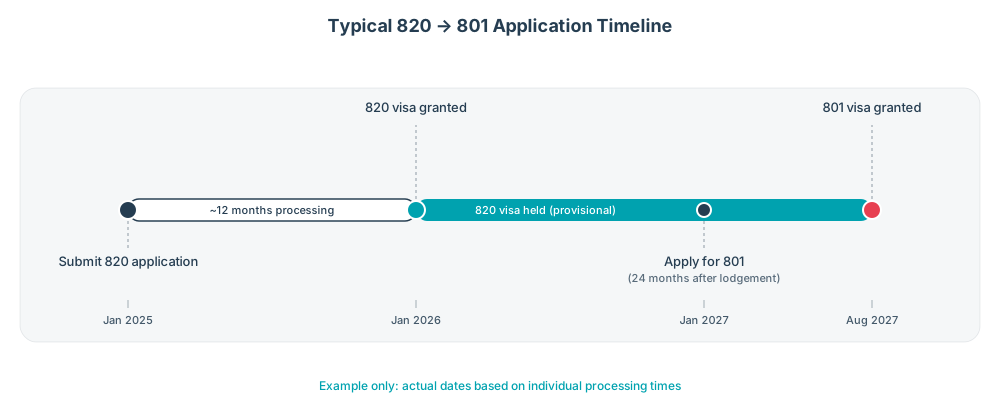
The subclass 820/801 Partner Visa is generally a two stage process, where you’re granted the subclass 820 visa first, and two years after lodging your initial Partner Visa application, you will be assessed for the subclass 801 visa (which is your permanent residency). I’ll talk more about the subclass 801 visa soon.
So unless you’re in a long term relationship, you will be granted the subclass 820 visa first. This is a provisional visa which allows you to live and work in Australia until a decision is made on your permanent application which is your subclass 801 visa. When you lodge your Partner Visa, you submit an application for the subclass 820 and 801 together, however, the subclass 801 is not assessed until 2 years after the date you lodged the application.
Just think of the subclass 820 visa as the ‘getting-to-know-you’ phase with Australian immigration. The subclass 801 is when they’re ready to commit.
Scenario for a typical onshore Partner Visa subclass 820/801
Let’s say you (the applicant) are here on a Working Holiday Visa. Provided you meet the legal criteria for a Partner Visa, you want to apply for the onshore Partner Visa (subclass 820) before the expiry of your Working Holiday Visa.
If you do decide to stay in Australia and live with your Australian partner, then the subclass 820/801 would generally be the route for you.
Eligibility for a subclass 820 visa
It’s important that you understand the eligibility criteria before you apply for a subclass 820 Partner Visa. It’s not as simple as being in a relationship with an Australian.
Here is some of the criteria you need to meet:
- You must be 18 years or older;
- You must married or in a de facto relationship with an Australian citizen, permanent resident or eligible new Zealand citizen;
- Your sponsor must not be prohibited from sponsoring you;
- Your sponsor must be 18 years of age;
- You must demonstrate your relationship is genuine and continuing;
- You must meet health and character criteria

Who can sponsor a subclass 820 Partner Visa?
When you and your partner apply for the onshore Partner Visa, you will both submit applications. Just like there are eligibility requirements for the applicant, there are also requirements the sponsor will need to meet.
To sponsor your partner for the subclass 820 visa, you will need to meet the following criteria:
- You must be 18 years or older;
- You must be an Australian citizen, permanent resident, or eligible New Zealand citizen;
- You must meet the character requirements
These are just the basic requirements, but there are other considerations you, as the applicant, should know before you lodge your Partner Visa. This includes whether your partner (the sponsor for your Partner Visa) has ever sponsored anyone else for a Partner Visa. If they have, how many other people? And when were these applications made?
If you’re not sure whether your sponsor meets this criteria, if they have character concerns or have previously sponsored someone else, it’s important you speak with a Registered Migration Agent or lawyer before proceeding.
Can dependent or secondary applicants be added to my application?
Yes, in some cases you can add a dependent applicant (or applicants) onto your Partner Visa. Any dependent applicants will also have criteria to meet. This can include, biological children, step-children or adopted children.
The Department has very strict criteria for who can be included on the application as a dependent. This can also vary depending on whether you are lodging an onshore (820/801) or offshore (309/100) Partner Visa.
If you are intending on including a child to the application, especially where the child is not a biological child of both you and your partner’s, then it’s important you speak with a Registered Migration agent or lawyer before proceeding.
Health requirements
The applicant (person applying for the visa) must meet certain health requirements. This includes undergoing a health examination with BUPA Australia.
It’s generally a good idea to complete the medical examination right after lodging your Partner Visa (or within a few months). This helps the application become ‘decision ready,’ but ultimately it’s a decision you and your partner need to make as visa medicals are only valid for 12 months. So in the scenario where you’ve completed your medical examinations, but it’s been 12 months and a decision hasn’t been made on your Partner Visa, you’ll need to not only complete the medicals again but also pay for them again.
Character requirements
Both the applicant and sponsor must meet the Department’s character requirements. You are both required to provide police clearances for any country you have lived in for 12 months or more over the last 10 years.
What is a de facto relationship?
You and your partner are in a de facto partner relationship if all of the following applies:
- You are not legally married to each other;
- You are committed to a shared life to the exclusion of all others;
- Your relationship is genuine and continuing;
- You live together or do not live separately and apart on a permanent basis;
- You are not related by family
Additionally, you and your partner must demonstrate that you have been in your de facto relationship at least 12 months before the application was lodged. There are exceptions to this rule, so if you haven’t been together for at least 12 months and want to find out more, it’s best to get immigration advice.
Evidencing your relationship for your Partner Visa
Evidence is key when it comes to your subclass 820 Partner Visa. It can ultimately make or break your application.
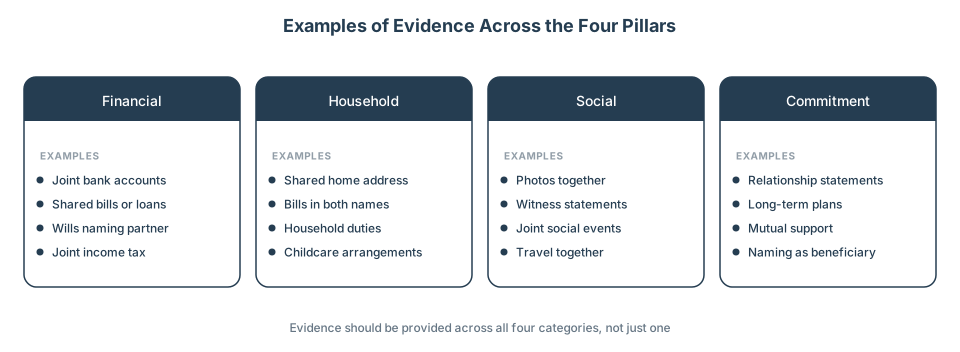
You must provide evidence to the Department of Home Affairs that your relationship is genuine and continuing. Your relationship will be assessed against four factors (otherwise known as the ‘four pillars of relationship’).
Some of the worst advice I’ve seen from people online is that you can just lodge a Partner Visa and then add your evidence as you go. This is such a risky way to go about it because if you’re not meeting certain legal criteria (e.g. demonstrating that you have been in a de facto relationship for 12 months before you lodge), then you’re risking a refusal.
Some other really bad advice I’ve read online is from people who say you won’t have an issue with getting a Partner Visa just because you’re from a certain country. The other day I read a comment on Reddit from a user who told someone else that because they are from the USA, they will get a Partner Visa. EEK!
Here are The Partner Visa Academy, you’ll have an Evidence Planning Session with me where I’ll help you navigate the ins and outs of your Partner Visa application, and we’ll create a personalised document checklist and strategy for your case.
Financial aspects of your relationship
The Department of Home Affairs will want to see how you and your partner share and manage your financial responsibilities. Examples of documents to provide can be:
- Joint bank statements;
- Wills;
- Joint loans and leases
For a more detailed explanation, read my full blog around the financial aspects.
The nature of your household
The Department of Home Affairs will want to see how you and your partner share household chores and responsibilities. Examples of documents to provide can be:
- Household bills;
- Mail sent to your joint address;
- Joint responsibility for any children;
- Statements about how you share your household chores
For a more detailed explanation, read my full blog around the nature of the household pillar.
Social aspects of your relationship
The Department of Home Affairs will want to see how you present your relationship to others and whether it’s known. Examples of documents to provide can be:
- Photographs;
- Form 888’s
- Witness statements;
- Joint invitations;
- Joint travel
For a more detailed explanation, read my full blog around the social aspects of your relationship.
The nature of your commitment
The Department of Home Affairs will want to see how you and your partner rely on each other and whether you view your relationship as a long term one. Examples of documents to provide can be:
- Relationship statements detailing the level of emotional and physical support you provide to one another.
- Any long term arrangements made to care for the other such as superannuation beneficiary documentation, wills, life insurance policies
For a more detailed explanation, read my full blog around the nature of your commitment.
How to know if you have enough evidence
As you can appreciate, lodging an onshore Partner Visa isn’t just about being in a relationship with someone. Not only do you need to make sure that you meet the criteria of either being in a ‘de facto’ or ‘spousal’ relationship, you also need to make sure you’re lodging at the correct time, your sponsor is actually eligible to sponsor you and that you’re across other requirements such as health and character.
It is difficult (if not impossible) to let a couple know whether they have enough evidence. Our team has spent years combing through Partner Visas so we know what works, and what doesn’t. As part of our Peace of Mind Package, we take the guessing out of it for you and we provide you with a complete review of your Partner Visa.
Cost of applying for the 820/801 Partner Visa
As of 1 July 2026, the visa application charge for a subclass 820/801 is $11,710, Yes! it’s a lot of money, but on the bright side, that’s still cheaper than a destination wedding!
Seriously, it’s expensive! So invest in getting the right level of support for your case.
Not sure what the right level of support is for you? You can start by reading my blog where I discuss whether you should DIY or have a professional manage your Partner Visa application.
Other costs to factor in before applying for your Partner Visa
In addition to paying the visa application charge, you may also incur other charges for lodging a Partner Visa. You should be prepared for the following costs:
- Police clearance;
- Health examination;
- Translating documents which are not in English
Processing times for onshore 820 Visa
Processing times vary greatly (and often) and are dependent on a number of factors. Processing times at time of publishing this blog are currently between 12-26 months.
There are a number of factors which help speed up the processing of your application such as:
- Ensuring all relevant documents are provided at time of lodgement;
- Ensuring all forms are completed in full;
- Responding to any requests from Immigration as soon as possible
There are of course scenarios that will see your application processing for potentially a very long time. This includes cases that might require a health waiver or where there are character issues.
For the relatively straight forward applications, the type that we help with at The Partner Visa Academy. The current processing times I’m seeing in September 2026 are around 20 months, now this may not be what you will see published on the Department of Home Affairs website and that is because they will be including all cases, including complex cases that will naturally take much longer to process.
As of September 2026, the Department’s website lists processing times for the 820 visa as 18 months for 50% of applicants and 32 months for 90% of applicants.

What is a long term relationship for the double grant subclass 820/801?
Some applicants may be granted their subclass 820 and 801 visas at the same time, this is often referred to as a ‘double grant.’ You may be eligible if:
- You and your partner have been in a de facto or marital relationship 3 years or more or;
- Two years if there is a dependent child of the relationship
I’ve written another blog specific to long term relationships and how the double grant works, so be sure to check that out if you think you may be eligible.
If you’re not eligible for a double grant, you can still be proactive during the waiting period between the first and second stages. Read my post about what you can do during the two year wait for more information.
When should you apply for your Partner Visa?
The timing of when you lodge your onshore Partner Visa is also really important. You should lodge your 820 visa before the expiry of your substantive visa. If you don’t hold a substantive visa or if you are unlawful in Australia, there are additional criteria you need to meet. We recommend you seek advice before proceeding if you are not the holder of a substantive visa or if you are unlawful inside Australia.
Note: If you’re going to be doing any travelling overseas while your onshore Partner Visa is processing, it’s important to make sure you have rights to re-enter Australia.
Bridging visas and the subclass 820 Partner Visa
The purpose of bridging visas is to bridge the gap between the expiry of one visa and the processing of another. For the onshore Partner Visa, the Bridging Visa A allows you to remain in Australia lawfully while waiting for a decision on your subclass 820 application.
If you intend to travel during the processing of your application, you will also need permission to exit and re-enter Australia, where your substantive visa has ceased. That’s where a Bridging Visa B comes in. For more on this, see my blog about applying for a Bridging Visa B from a Bridging Visa A.
An important note: not everyone will be granted a bridging visa. You must be holding a substantive visa, and you must not be holding a visa with any conditions that would prevent applying for an onshore visa (for example, an 8503 No Further Stay Condition).

What if the relationship breaks down during processing?
Unfortunately, this does happen. If you find yourself in this situation, it’s best to seek independent advice from a Registered Migration Agent or lawyer as the next steps are entirely dependent on your circumstances.
This is something the team at Freedom Migration can advise on.
Can I work after I have lodged my subclass 820/801 visa
This will very much depend on what visa you held at time of lodging the 820 visa. It’s important to note that you must comply with the conditions of the current visa you hold, even if you have lodged a subclass 820 Partner Visa.
Some visas already carry work rights with them, such as a Working Holiday Visa or Student Visa. Other visas, such as Visitor Visas do not allow a visa holder to work, and in these cases you would need to wait for your Bridging Visa A to come into effect before you start working.
The safest way to ensure you are complying with your visa conditions is to complete a VEVO check after you have lodged your subclass 820 Partner Visa and after the expiry of your current visa. The VEVO check will confirm what visa you hold, any expiry dates and the visa conditions you must comply with.
What rights will I have on my subclass 820/801 visa?
The subclass 820 Partner Visa gives you rights to:
- Live lawfully in Australia with your partner;
- Travel overseas and re-enter Australia;
- Work and study in Australia;
- Access Medicare
What is a subclass 801 Partner Visa?
So let’s say you’ve lodged your 820 Partner Visa, and it’s been finalised (yay). What’s next? Your 801 Partner Visa application!
I briefly mentioned the subclass 801 visa at the start of this blog, so let’s go further into what it actually is. First thing to know, the process doesn’t end when you’re granted your subclass 820 visa.
A subclass 801 Partner Visa is the permanent stage to your 820 Partner Visa application. This is the visa that lets you live in Australia permanently.
Unfortunately I’ve seen way too many cases of couples forgetting all about it and ultimately having their subclass 820 wasted. Immigration MUST make a decision on your subclass 801 visa and if you haven’t applied for it, or simply forgotten (as some people do), then you’re putting your subclass 820 visa and all that hard work (and money) at risk.
When can I apply for my subclass 801 Partner Visa?
You’re eligible to apply for your subclass 801 Partner Visa 24 months after your subclass 820 visa was lodged.
Some other bad advice I see people give online is around the timing of applying. You should apply as soon as you’re eligible. I’ve often seen people say that you need to wait until you’re invited by Immigration to apply. This simply isn’t true. Put a note in your calendar and apply after 24 months of when you lodged your subclass 820 visa.
Remember that it’s 24 months since the subclass 820 was lodged, NOT from it was granted (another common mistake).
What does the process typically look like?
Sometimes it’s easier to explain the process with a chart, so here’s what the process looks like. Remember the processing times will vary.
How do I lodge the application for my subclass 801 Partner Visa?
You’re going to use your good friend, the ImmiAccount, again to lodge this application.
What documents do I need for my subclass 801 Partner Visa?
I like to call the subclass 801 Partner Visa process putting together a ‘mini Partner Visa’ because you’re basically putting together a Partner Visa application again.
There are some differences in the forms you need to complete and evidence provided, but ultimately you need to demonstrate to the Department that you are still in a genuine and continuing de facto or spousal relationship. You can take a refresher on the four pillars of relationship, because it’s important your evidence covers these pillars again.
What happens after the subclass 801 visa is granted?
After your subclass 801 (permanent) Partner Visa is granted, congratulations! You’re now a permanent resident of Australia. Your permanent visa comes with a travel facility period of five years that allows you to leave and re-enter Australia. After that five year period, you’ll need to apply for a Resident Return Visa if you intend to travel overseas, and return to Australia.
You may also consider applying for citizenship when you become eligible. For more on this, I’ll refer you to the Department’s website on becoming an Australian citizen.
It’s also important to consider establishing and building your life here in Australia. If you’ve been onshore throughout the visa process, you’ve likely already started this process. It’s easy to rely on your partner with how demanding the Partner Visa journey is, but having friends and getting involved in the community beyond your relationship is necessary for a happy and full life. I’ve written all about this previously. You can read more in my blog about life after your Partner Visa.
The takeaway
My takeaway from all of this is that both the subclass 820 and 801 Partner Visas have really stringent criteria. The good news is that you don’t need to pay another fee when you lodge the subclass 801 Partner Visa, but don’t waste the investment you’re making in the subclass 820 but making silly mistakes in your application to begin with.
Remember; applying for a Partner Visa is kind of like a relationship endurance test, if you can survive the paperwork, you’ve probably got this!
IMPORTANT: Please note, this does not constitute Immigration advice. Always seek advice from a Registered Migration Agent before applying for an Australian Visa. Migration Law is constantly changing. This information is accurate only at the time of publication.


